
Castelletto e Grotta del Belvedere
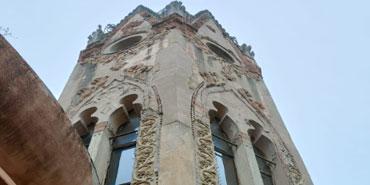
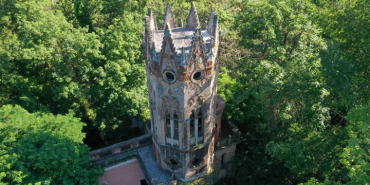
In the turret, one ascends via an elegant stone spiral staircase to the room of the Belvedere, equipped with a neogothic double window on each side of the octagon. Outside, the walls reveal an eclectic style typical of the neogothic, with an alternation of elements derived from Gothic, flamboyant Gothic, and Renaissance styles.
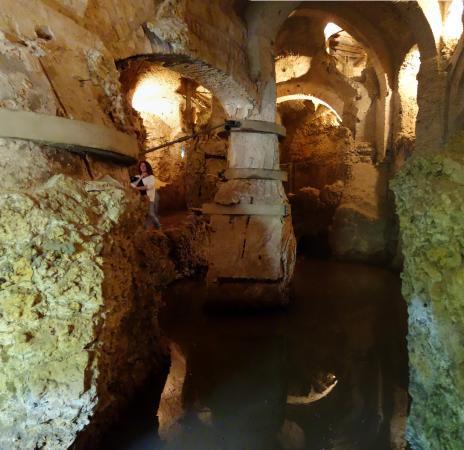
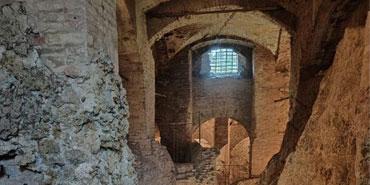
The turret conceals a mysterious cave richly articulated in several compartments, communicating with the Villa through a tunnel that has since been bricked up, while other underground pathways, now blocked, are said to have led to nearby castles (in Noale and Stigliano; and also to Castelliviero and Salzano). To complete this ensemble, a beautiful artificial lake extends beside it, which was formed by excavating material to create the elevation, and whose waters also emerge at the bottom of the cave. The underground route of about 250 meters is well-articulated in an alternation of caves, recesses (one of which is equipped with an artificial pond), galleries, tunnels, etc., and opens up outdoors, where it winds through a continuous, evocative ascent and descent along romantic paths, characterized by avenues, stairways, little bridges, leading to the lake and its wooded islands, one of which, facing the Villa, existed until the early twentieth century.
It is interesting to note how a large number of meanders, nooks, caves, and tunnels make the exploration of the path extremely varied, one noteworthy stop, certainly among the most important, is represented by a stone with chains that was meant to simulate an ancient prison of the Castle, where the condemned were tied.
This is a charming yet fascinating nineteenth-century complex wanted by Vincenzo Paolo Barzizza, son of Antonio Vincenzo Barzizza and Giovanna Erizzo (the last heir of the noble Erizzo family), with the aim of creating a secluded and privileged place to retreat into oneself or in the company of intellectual friends with whom he often enjoyed socializing.
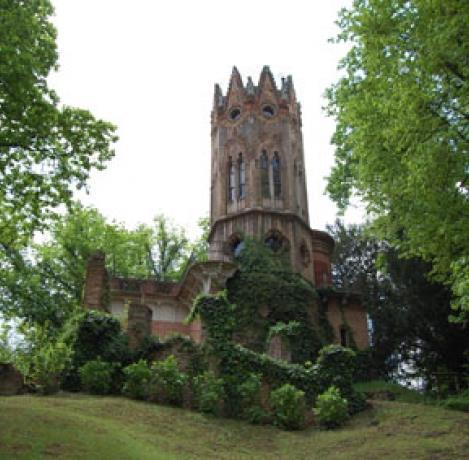
The site, more than just a simple tower, is a vast complex in the shape of a small castle, featuring, in the layout, four rooms (two left open to the sky from the very beginning) next to which rises the octagonal tower with five floors, on the remains of a cylindrical base, a fake ruin where an arched window with a pointed arch opens.
In the tower, one ascends via an elegant stone spiral staircase to the room of the true Belvedere, equipped with a neo-Gothic bifora on each side of the octagon, from which the view indeed extends all around for 360 degrees. In the final stretch, a spiral staircase leads to the top floor, which consists of a terrace adorned with battlements, from which an even wider panorama can be admired.
Inside the small castle, built between 1840 and 1850, there are still remnants of a fresco by the nineteenth-century artist Giovanni De Min depicting "Venice in History and the Arts."
The small tower hides beneath it a mysterious cave, richly articulated into several compartments, communicating with the Villa through a tunnel that has since been bricked up, while other underground paths, now blocked, are said to have led to neighboring castles (in Noale and Stigliano; and also to Castelliviero and Salzano). The underground itinerary measures about 250 meters and is well articulated in alternation of caves, galleries, and tunnels with a small lake that flows outdoors, winding through a continuous and evocative ups and downs.
Next to the tower extends an artificial lake, excavating which has allowed the formation of the mound for the small castle. The architectural complex is located in a charming English garden situated between the Mulini di Sopra and the Mulini di Sotto, in the historic center of Mirano and along the Muson.
Open on Sundays and public holidays in the months of:
APRIL, MAY – JUNE – SEPTEMBER OCTOBER
Hours: 3:00 p.m. – 6:00 p.m. with guided tours of 1 hour.
Guided tours will be conducted by reservation only.
Extra opening during closure periods for groups of 15 or more.
 Email
Email
 Telefono
 Website